Getting Better at Squash Is More Boring Than You Think
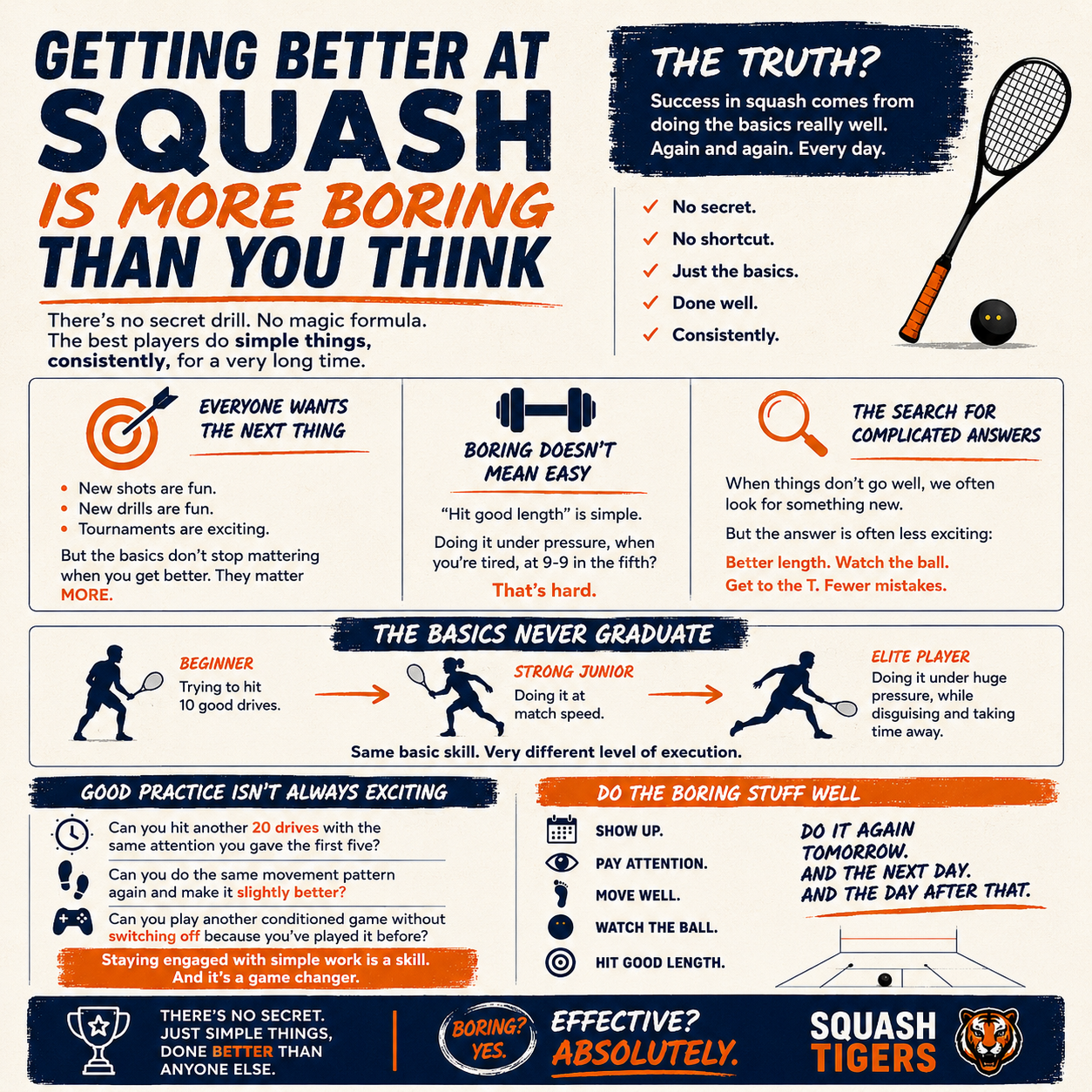
We'd love to tell you there's a secret.
A drill we've discovered. A new training method. Something the best players know that everyone else doesn't.
Unfortunately, after a lot of years coaching squash, we haven't found it yet.
Getting good at squash is actually pretty boring.
We were reminded of this reading a recent piece by Sahil Bloom about success. One of his points was that people tend to imagine success as something complicated, when in reality it usually comes down to doing relatively simple things consistently, for a very long time.
That sounds a lot like squash.
Everyone wants the next thing
Young players naturally like learning new things.
New shots are fun. New drills are fun. Playing someone different is fun. Tournaments are exciting.
Hitting straight drives for the thousandth time?
Slightly less exciting.
But there's a reason you'll still see very good players doing incredibly simple practices.
They're not doing them because nobody has shown them anything more advanced.
They're doing them because the basics don't stop mattering when you get better.
They matter more.
Boring doesn't mean easy
“Hit good length” sounds simple.
Actually hitting good length, under pressure, when you're tired, at 9–9 in the fifth, against somebody trying very hard to stop you doing it, is something else entirely.
The same goes for watching the ball.
Getting back to the T.
Preparing the racket early.
Moving efficiently.
Taking the ball before it gets behind you.
None of these ideas are particularly exciting. None will make a great YouTube title.
But being able to do them consistently is incredibly difficult.
That's the difference.
The basics are simple.
Mastering them isn't.
The search for complicated answers
As coaches, we see this quite a lot.
A player is struggling and immediately starts looking for something new.
Maybe I need a different swing.
Maybe I need to attack more.
Maybe I need another shot.
Maybe I need a new racket.
Sometimes they do.
But quite often the answer is considerably less exciting.
Your length wasn't good enough.
You stopped watching the ball.
You were late getting back to the T.
You made too many mistakes.
That's not particularly glamorous coaching advice, but fixing those things tends to work.
Good practice doesn't always look exciting
There's also a difference between making practice entertaining and making every minute of practice different.
We absolutely want young players enjoying their squash. That's a huge part of keeping them in the sport long enough to become good at it.
But development also requires learning to concentrate when something isn't new anymore.
Can you hit another 20 drives with the same attention you gave the first five?
Can you do the same movement pattern again and make it slightly better?
Can you play another conditioned game without switching off because you've played it before?
That ability to stay engaged with simple work is a skill in itself.
And the better players get, the more important it becomes.
There's no graduation from the basics
You don't reach a certain rating and graduate from hitting good length.
There isn't a point where watching the ball becomes optional.
The fundamentals follow you all the way up.
What changes is the level at which you can execute them.
A beginner might be trying to hit ten consecutive drives.
A strong junior might be trying to hit that same target while moving at match speed.
An elite player might be trying to do it under enormous pressure while disguising the shot and taking time away from their opponent.
Same basic skill.
Very different level of execution.
Do the boring stuff well
There are obviously lots of things that go into developing a squash player.
Good coaching matters. Competition matters. Strength and conditioning matters. Tactics matter. Having fun matters.
But sometimes we probably make improvement more complicated than it needs to be.
Show up.
Pay attention.
Move well.
Watch the ball.
Hit good length.
Do it again tomorrow.
And then keep doing it when you're good enough to think you shouldn't have to anymore.
Unfortunately, that's about as close to the secret as we've found.
This post was inspired by Sahil Bloom's “9 Harsh Truths Nobody Told You About Success,” particularly his point that success is often much simpler than we imagine and comes from consistently executing the basics.